
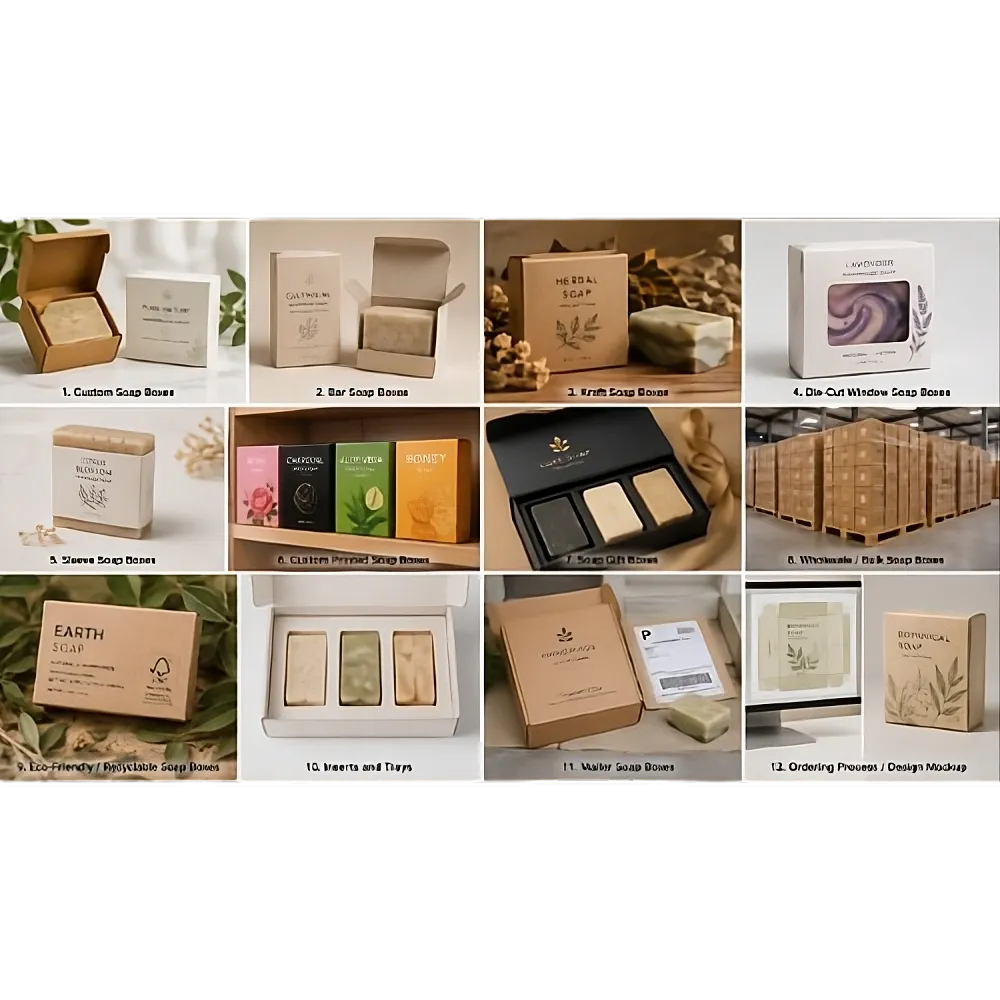
Custom Soap Boxes: The Complete Guide to Packaging, Materials, Pricing, and US Label Compliance
Whether you press 40 cold-process bars in a home studio on Sunday afternoons or ship pallets of retail soap to distributors every week, custom soap boxes do more work than any other single element of your brand. They protect a fragile, oil-rich product, carry every word the law requires you to disclose, and — on a crowded shelf or a marketplace thumbnail — decide in about three seconds whether a shopper reaches for your bar or someone else's. This guide is written for three very different readers, and each of you will find your section below.
If you are a bulk or wholesale B2B buyer, you care about the lowest realistic per-unit cost, honest price tiers, and turnaround you can plan a production calendar around — skip ahead to pricing and wholesale. If you are a small-batch, handmade, or startup soap maker, you need a low minimum order, an affordable kraft look that photographs well, and a plain-English walkthrough of how ordering actually works — we have built this guide around you too. And if you represent a gift, retail, or premium brand, your questions are about finishes, window boxes, the unboxing moment, and using genuine sustainability as a premium signal rather than a sticker. Nexon Packaging produces soap packaging boxes for all three, and the sections that follow are organized so you can read only what applies to you or the whole thing end to end.
Why Soap Packaging Is Its Own Discipline
Soap is not a dry, inert product. Cold-process and glycerin bars keep releasing trace oils and moisture, fragrance oils can migrate, and a naked bar picks up scuffs and fingerprints the moment it leaves your hands. Good soap packaging has to breathe a little, resist oil staining, and still look intentional. That is why material choice, ink chemistry, and structural format matter far more here than they would for, say, a phone accessory. Throughout this guide we will name specific materials and certifications rather than leaning on the word "eco-friendly," because in the US soap market both your customers and — as you will see — federal regulators expect specifics.
Custom Soap Box Styles: Choosing the Right Format
There is no single "soap box." The right structure depends on your bar, your price point, and where the product is sold. Below are the formats Nexon produces most often, with the trade-offs that actually drive the decision.
Bar Soap Boxes
The workhorse format is the straight-tuck or reverse-tuck carton sized to a single bar. Our standard bar box runs roughly 3.5 × 2.5 × 1 inch (about 85 × 55 × 30 mm), which fits a typical 100g bar snugly without rattling. A tight fit is not cosmetic — movement inside the box is what rounds off corners and wears the print during shipping. Bar soap boxes give you full surface area for branding and ingredient copy, close securely, and stack cleanly on a shelf, which is why they remain the default for most retail lines.
Kraft Soap Boxes
Kraft soap boxes are the natural starting point for handmade and artisan lines. Printed on FSC-certified kraft, the brown, uncoated surface signals "natural" and "small-batch" before a customer reads a word, and it pairs beautifully with one- or two-color soy-based ink for a clean, earthy look. Kraft is also forgiving on budget because a minimalist kraft design often needs only a single PMS color rather than full-color printing. For startup soap makers building a handmade soap packaging aesthetic, cardboard soap boxes in kraft are usually the most cost-effective way to look deliberate rather than improvised.
Soap Boxes With a Die-Cut Window
Soap boxes with a window let the bar sell itself — the color swirl, the botanical inclusions, the texture. A die-cut window can be left open or backed with a clear film, and the shape can echo your logo or the bar itself. Windows are especially effective for visually striking soaps where the appearance is the selling point. The trade-off is that an open or filmed window reduces full enclosure, so we help you balance the opening size against protection, and we place the cut so it does not weaken the box's structural folds.
Sleeve Soap Boxes
A soap sleeve is a printed band or belly-wrap that hugs the center of the bar, leaving the top, bottom, and ends exposed. Sleeves use the least material of any format, cost the least per unit, and let the customer see, smell, and feel most of the bar directly — a big advantage for artisan sales at markets and in stores that encourage handling. The trade-off is minimal physical protection and less printable real estate, so sleeves suit makers whose bars are robust and whose brand story is short and confident.
Custom Printed Soap Boxes
When brand recognition is the goal, custom printed soap boxes give you the full canvas: full-color CMYK for photographic artwork and gradients, PMS spot colors for exact brand matching, and specialty finishes on top. This is where a line starts to look like a brand rather than a batch. Printed soap boxes carry your logo, your palette, and your required label copy in one coordinated system, and consistent print across every SKU is what makes a shelf set read as one family.
Soap Gift Boxes
Soap gift boxes are built for the premium and seasonal market, where the box is part of the present. These often use rigid setup board for a substantial, hand-feel weight, and lean on finishes — soft-touch matte lamination, spot UV, foil stamping, embossing — to create an unboxing moment. Multi-bar gift sets, magnetic closures, and fitted trays all live here. For gift and retail brands, this is where sustainability doubles as a premium signal: a heavyweight recycled board box with foil detailing reads as both luxurious and responsible.
Wholesale Soap Boxes (Bulk)
For B2B buyers, wholesale soap boxes are about predictable unit economics at volume. Ordering in the thousands or tens of thousands pushes the per-unit price down sharply (see pricing below), and standardizing on a common box size across several SKUs compounds that saving. Soap box packaging wholesale is where turnaround planning and tier pricing matter most, and where a physical proof before the full run protects you from an expensive mistake replicated ten thousand times.
Eco-Friendly and Recyclable Soap Boxes
Eco-friendly soap boxes only mean something when they name the material. Ours are built from FSC-certified kraft and recycled, recyclable paperboard (SBS/C1S), printed with soy-based and food-safe inks rather than conventional petroleum inks. Kraft and uncoated paperboard are curbside-recyclable and biodegradable; heavy lamination and certain foils can compromise recyclability, so if a clean end-of-life story is central to your brand we will steer the finish choices accordingly. This is sustainability you can defend with specifics — which is exactly what a discerning US buyer now expects.
Soap Boxes With Inserts and Trays
Inserts and fitted trays hold a bar (or several) precisely in place, which matters for multi-bar sets, delicate shapes, and premium presentation. A molded or die-cut paperboard tray stops bars from shifting, keeps a gift set looking arranged rather than jumbled, and adds a layer of perceived quality. Inserts are also a practical protection upgrade for softer artisan bars that would otherwise abrade against the carton wall in transit.
Mailer Soap Boxes
Direct-to-consumer and subscription brands ship soap through the mail, and a standard tuck carton is not built for that journey. Mailer soap boxes use corrugated e-flute — a thin but rigid fluted board — to survive the courier network while staying light enough to keep postage reasonable. E-flute takes print well, so your mailer can be as branded as your shelf box, turning the delivery itself into part of the customer experience.
Materials, Inks, and Sustainability — the Specifics
Every custom soap packaging decision starts with substrate. Nexon works in four main materials, each suited to a different job:
FSC-certified kraft is the natural, uncoated brown board behind most artisan and handmade soap packaging — recyclable, biodegradable, and certified to responsible forestry standards. Recycled and recyclable paperboard (SBS/C1S) is the smooth white board that makes printed soap boxes pop; C1S (coated one side) gives you a crisp printable face with an uncoated interior. Corrugated e-flute adds shipping durability for mailer soap boxes without much added weight. Rigid setup board delivers the dense, premium feel that soap gift boxes depend on.
On top of those, we print with soy-based and food-safe inks. That matters for two reasons: soy inks are lower-VOC and keep recycled fiber cleaner in the recycling stream, and food-safe formulations avoid the migration concerns that come with conventional inks near a product people rub on their skin. The FSC certification and recycled content are not decoration — they are the claims that let you market sustainability honestly, and they are traceable to real standards rather than a vague green promise.
How to Order and Design Your Custom Soap Boxes
The process is built to be approachable whether you are ordering 100 boxes or 100,000. Here is the step-by-step path from idea to delivered cartons.
- Pick your format and size. Choose a style from the sections above and confirm dimensions. If you are unsure, our standard ~3.5 × 2.5 × 1 in bar box fits a typical 100g bar; we can build any custom size around your specific bar.
- Choose material, printing, and finishes. Select your substrate (kraft, paperboard, e-flute, rigid), your printing method (CMYK, PMS, or foil), and any finishes, window die-cut, or inserts. These are the levers that set both look and price.
- Get free design and 3D mockups. Our team creates your artwork at no charge and delivers 3D mockups so you can see the box before it exists — with unlimited artwork revisions until it is right.
- Approve a physical proof. Before any bulk run, you can approve a physical proof or sample. Seeing and holding the real box — the print, the fit, the finish — is the single best safeguard against a costly reprint.
- Production and delivery. Standard turnaround is 8–10 business days, with a 4–6 business day rush option, and shipping across the US is free.
The low minimum order — as low as 100 units — means startups and small-batch makers can order real custom packaging without warehousing thousands of boxes, then scale up as demand grows.
Custom Soap Box Pricing by Order Volume
Per-unit price on soap boxes is driven by five things: material, printing method (CMYK vs PMS vs foil), finishes, window die-cutting, and inserts. Higher volumes spread fixed setup costs across more boxes, which is why the per-unit number falls sharply as you scale. As a realistic guide (USD per unit):
- Small batch (100–500 units): roughly $0.60–$1.10 per unit — the startup-friendly tier, ideal for testing a design or launching a line.
- Medium (1,000–5,000 units): roughly $0.08–$0.31 per unit — where growing brands find their sweet spot.
- Bulk (10,000+ units): from about $0.06 per unit — the lowest per-unit cost, built for wholesale and distribution.
These are ranges, not quotes, because your exact specification moves the number. For any bulk order we recommend approving a physical proof before the full run. When you are ready to compare your own spec against these tiers, browse Nexon's full range of custom soap boxes and request a tailored quote.
US Soap Box Label Requirements: What the Law Actually Says
This is where many new soap brands get tripped up, so it is worth getting right. In the United States there is no single "soap label law." What applies to your box depends on how your product is classified — and that is driven by your ingredients and your marketing claims, not by the word "soap" on the label.
True soap (essentially alkali salts of fatty acids, marketed only as soap for cleaning) is regulated by the Consumer Product Safety Commission and the Federal Trade Commission. A cosmetic is any product marketed with a claim like moisturizing, softening, or a scent benefit — and that is regulated by the FDA. A drug is anything claiming to treat or prevent a condition (antibacterial, acne treatment, eczema relief), which triggers stricter FDA drug requirements. In practice, most handmade soap that makes a scent or moisturizing claim is legally a cosmetic, not true soap.
Regardless of classification, the Fair Packaging and Labeling Act (FPLA, 15 U.S.C. §1451), enforced by the FTC, requires every consumer package to show three things: (1) the product identity, (2) the net quantity of contents, and (3) the name and place of business of the manufacturer, packer, or distributor. Source: FTC — Fair Packaging and Labeling Act.
If your product is a cosmetic, FDA cosmetic labeling rules in 21 CFR Part 701 also apply: an ingredient declaration listed in descending order of predominance (§701.3) and a net-quantity statement (§701.13). Source: eCFR — 21 CFR Part 701. True soap has a labeling exemption under 21 CFR 701.20; the FDA explains the soap-versus-cosmetic distinction in its soap FAQ: FDA — Frequently Asked Questions on Soap.
Finally, the Modernization of Cosmetics Regulation Act (MoCRA, 2022) added FDA facility registration and product listing obligations for cosmetics, and your label needs a US contact for adverse-event reporting. Nexon designs boxes with these obligations in mind — we leave clean, legible room on the panel layout for your identity statement, net-quantity line, full ingredient declaration, and contact information, so your artwork does not have to be reworked to become compliant.
This is general information, not legal advice — confirm the requirements for your specific product with a compliance professional.
Frequently Asked Questions
What is the standard size for a soap box?
There is no legally fixed size, but a common standard for a single bar is about 3.5 × 2.5 × 1 inch (roughly 85 × 55 × 30 mm), which fits a typical 100g bar well. Because bars vary, the box is best built to your exact bar so the fit is snug and the print stays protected in transit.
Is cardboard or paperboard safe for packaging soap?
Yes. Paperboard and kraft are well suited to soap: they let the bar breathe slightly, resist oil staining when specified correctly, and are recyclable. For bars shipped through the mail, corrugated e-flute adds the durability a thin carton cannot. The key is matching the board weight and format to how the soap will be stored and shipped.
Do you need food-safe or special ink to print soap boxes?
Soap sits against the skin, so we print with soy-based and food-safe inks rather than conventional petroleum inks. This lowers VOCs, keeps recycled fiber cleaner in the recycling stream, and avoids the migration concerns associated with harsher ink chemistries near a personal-care product. It is a small choice that both regulators and eco-minded customers notice.
Are kraft soap boxes biodegradable and recyclable?
FSC-certified kraft and uncoated recycled paperboard are both curbside-recyclable and biodegradable. Be aware that heavy lamination and some metallic foils can reduce recyclability, so if a clean end-of-life is central to your brand, favor minimal or uncoated finishes — we will help you choose combinations that keep the box genuinely recyclable.
What is the difference between a soap sleeve and a tuck-end box?
A sleeve is a printed band that wraps the middle of the bar, leaving most of it exposed — it uses the least material and lets customers see and smell the soap directly, but offers minimal protection. A tuck-end box fully encloses the bar, protecting it and giving you far more surface for branding and required label copy. Sleeves suit market and artisan sales; tuck boxes suit retail shelves and shipping.
What must legally appear on a soap box label in the US?
At minimum, the FPLA requires product identity, net quantity of contents, and the manufacturer or distributor's name and place of business. If your product is classified as a cosmetic, FDA rules add a full ingredient declaration in descending order of predominance and a net-quantity statement, and MoCRA adds a US adverse-event contact. Exact requirements depend on your product's classification, so confirm yours with a compliance professional.
Ready to Package Your Soap?
From a first 100-unit kraft run to a 50,000-box wholesale program, Nexon Packaging builds soap boxes that protect your product, carry your brand, and leave room for everything the law requires. You get free design and 3D mockups, unlimited revisions, a physical proof before any bulk run, standard 8–10 business day turnaround (4–6 with rush), and free US shipping. Explore the full range of soap box options and request your free quote and design mockup today — tell us your bar size and your vision, and we will handle the rest.
Get a Quote for Your Custom Soap Boxes
Tell us your bar size, quantity, and the look you're after, and we'll send a free quote with 3D mockups. Order from 100 units, get free design support and free US shipping, and have retail-ready soap packaging in hand in as little as 15–20 days. Request your custom soap boxes quote today.